
Augustus 2025
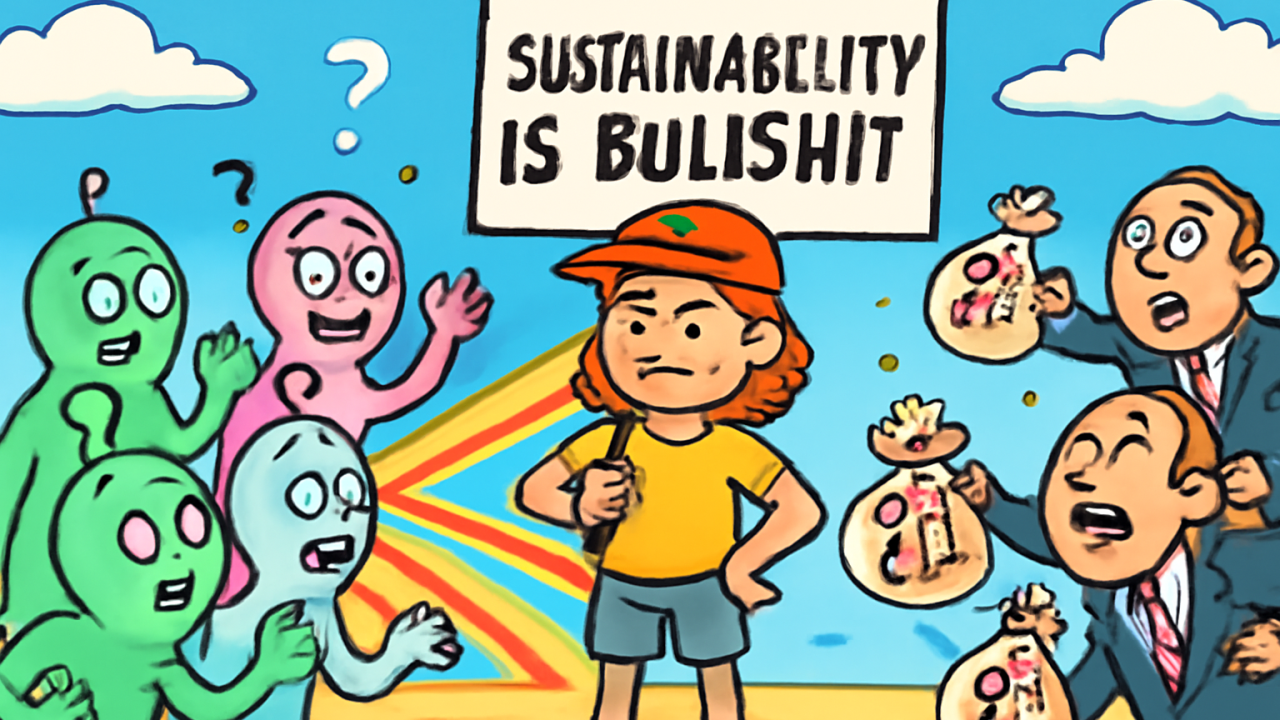
No, I haven’t lost my mind. I wasn’t abducted by aliens, bribed by Big Oil, or intimidated into changing my views by Trump and his allies. Sustainability is Bullshit is simply the title of a talk I used to give as a CSR officer—and I still stand by it. Let me explain.
Just another option
What I’ve observed, again and again, is that sustainability is treated like an accessory—something nice to have, but never essential. It’s often the first thing cut when budgets shrink or politics get in the way. To many, it remains just another item on an endless checklist. But that completely misses the point. To live unsustainably is not just another decision —it is deeply unethical. Unsustainability means people and the planet suffer. Sustainability, on the other hand, is a vision of a world where air and water are clean, where work and living conditions are fair, where diversity and inclusion are the norm, and where the climate is safe and stable. That is not a luxury—it is the only just future.
Why are we not living sustainably?
Perhaps people don’t truly grasp what sustainability means. Or perhaps they do, but prefer to look away. Life is full of distractions, and uncomfortable truths are easy to ignore—especially when we’re cushioned by the conveniences of consumerism. Add to this the persistent myths—such as “sustainable always equals expensive”—, the default option of unsustainable products, the poison of greenwashing, and no wonder many feel change is impossible. For too many, imagining the end of the world is easier than imagining the end of short-term, consumer-driven excess.
And yet, it’s outrageous that in 2025 we are still talking about “shifting” toward sustainability. That we act as though it’s an optional journey we might get around to someday. This is bluntly, bullshit. Not because sustainability is meaningless, but because it should have been the norm a long time ago. The fact that it isn’t tells us something sobering: we have been living for generations in a profoundly broken system.
Is the Word the Problem?
Some argue that the very term sustainability has lost its power—that it has been watered down by corporate greenwashing, or that people are simply tired of hearing it. They suggest new terms: regeneration, deep change, or something else more inspiring. I can see the appeal of language that captures transformation more vividly, and there’s nothing wrong with adapting terminology to fit the context.
But words are not the real issue. The problem is that, time and again, we continue to act in ways that destroy life. It is still socially acceptable—and often still profitable—to drill relentlessly for oil, to dump toxins in the earth, or to buy products made with forced labor. Let’s be honest: this is not just unsustainable. It is wrong. It is exploitation and, at its core, it is evil.
The Illusion of Separation
What underpins this destructive behavior is a dangerous illusion: the belief that we are separate from one another and from the living systems of this planet. That somehow my existence is disconnected from the oceans, the forests, the soil, the air, or even from other people. But this is a lie.
The truth is interconnection. We are woven together in a vast web of dependence, whether we acknowledge it or not. Sustainability is not just an ethical demand—it’s an existential one. When we recognize the reality of this interdependence, the only rational path is to create systems that sustain life rather than destroy it.
Where Do We Go From Here?
You may have noticed that I use “we” throughout this essay. That is deliberate. I include myself because I’m not immune to struggle. I, too, falter in my daily choices. But I also use “we” because no single person can solve this alone. The system itself stacks the deck against sustainable choices, making the destructive option cheaper, easier, and more available. That’s why systemic change is essential.
Still, there’s hope. Courage matters. The next time someone suggests cutting a sustainability initiative, remember: it is not optional. Speak up. And the next time you’re faced with choosing between convenience and responsibility, lean on the knowledge that supporting life is always the meaningful choice. Sustain what sustains us. Because anything less is just unacceptable.
At the same time, show yourself compassion. If you slip, if you make a decision that isn’t aligned with your values, don’t waste energy on shame. Learn from it, recommit, and keep going. The fight for a sustainable world is daunting, but you are not unreasonable for insisting on it. The unreasonable thing is the system that resists it.